After 10 years of teaching, I left the classroom in 2023. I’ve earned an Ed.S. and passed comprehensive exams in the fall of 2025, making me a Candidate for a Ph.D. in Teacher Education. I research grading and classroom assessment, and work with pre-service educators. Here are my most up-to-date practices—frozen in time like Pompeii or Herculaneum right up to my last day in the classroom—that were fundamental to my teaching, making all the daily activities possible…
Continue readingTrue Formative Assessment Model (TFAM) & Guidance Phases
This is an update to my 2024 presentation and assessment model reflecting insights from a continued review of classroom assessment and grading literature, findings from a new pilot study, and a novel framing of the formative assessment process I call Guidance Phases. Here’s a summary of the updates:
- A few literature sources removed; many new ones added
- The labeling and categorizing of assessments that mix characteristics has been abandoned to keep the focus on avoiding false formatives and incorporating more true formatives.
- Rather than a characteristic, the role of self-assessment has been expanded to fall under Guidance Phases as part of the feedback cycle; it no longer appears in the Venn diagram.
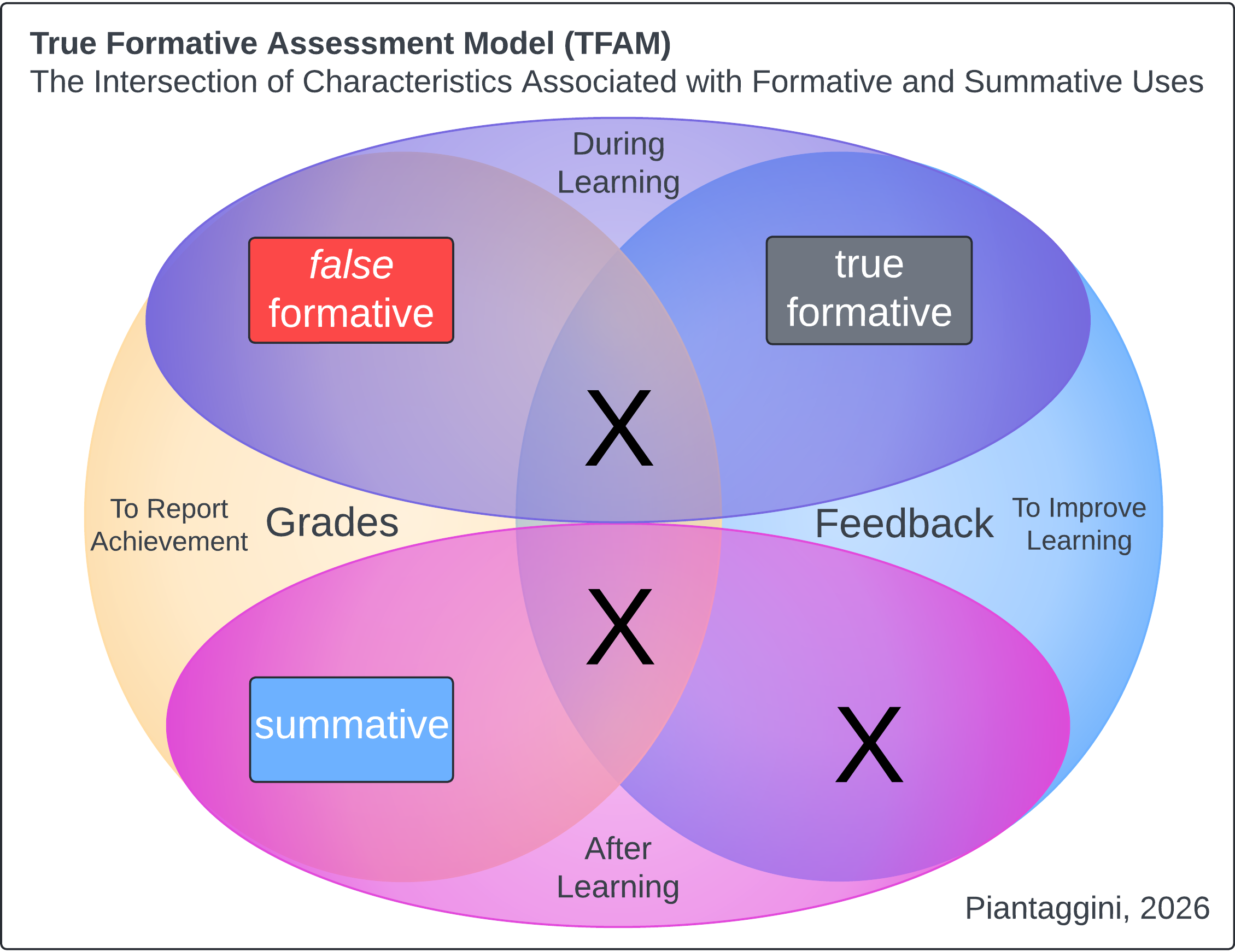
- Assessments, themselves, cannot be formative or summative. It is the use that determines one or the other. Therefore, I’ve clarified that the terms “formative” and “summative” in this model refer to characteristics. For example, a true formative is an assessment used in a formative way as seen through its associated characteristics (and not other characteristics associated with a summative use).
True Formative Assessment Model (TFAM)
This is the name of my model using a Venn diagram to show the intersection of assessment characteristics associated with formative and summative uses:
SE3R: Addendum to Mark Barnes’ SE2R
When presenting Mark Barnes’ SE2R model at the 2025 MTA Summer Conference, there was a comment that not all feedback has to be negative. I mistook this for encouraging praise, but the participant clarified that they don’t always find flaws to correct (i.e., their meaning of “negative”). My response was something like “oh, by all means if a student is meeting expectations definitely tell them that,” then continued my presentation.
It wasn’t until months later that I fully processed that interaction and realized something was missing from my presentation. If teachers should be telling students to continue what they’re doing, the feedback model should account for that. Therefore, I offer a slight tweak to Mark’s model, adding another “R” to represent “reassure.”
SE3R
Mark’s model is Summarize, Explain, Redirect, Resubmit. This works really well when there’s something for the student to work on, but what if they meet expectations? We can’t be using such a deficit mindset—perhaps what the workshop participant was thinking, too—that we leave out students who are doing what we expect (or more). Therefore, after Summarizing and Explaining, there are two paths a teacher can take: Reassuring, or Redirect/Resubmit:
- Summarize (e.g., “You wrote a one-page summary of the topic.”)
- Explain (e.g., “You defined the similarities between X and Y.”)
- Reassure (e.g., “This is really effective; keep doing it!”)
-or-
Redirect/Resubmit (e.g., “Add supporting statements, then send it to me in an email.”)
Read This: Going Gradeless (Burns & Frangiosa, 2021)
The authors document changes made to their grading and assessment practices while “going gradeless” in an effort to reduce grading. You should read this for all their “why?” reasons for doing so, along with the many rubrics and learning progressions to get you thinking. I wouldn’t recommend implementing everything as-is, but their journey could really help you think about what you should be thinking about.
Continue readingCurrent Reading: Standards-based Grading (SBG)…Too Much Grading?
I’ve been sitting on this post for a very, very long time, perhaps because I hadn’t been entirely confident in my review of classroom assessment literature enough to make a claim about standards-based grading (SBG) that isn’t exactly positive. In short, the literature suggests that practices most likely to support learning are achieved by keeping graded summative assessments to a minimum.
SBG might not be doing this.
Continue readingClassroom Assessment & Grading Roadmap
I left my 2025 MTA Summer Conference workshop participants with a LOT of resources to read. After getting through all the recommended posts and maybe even books, however, they’ll probably still face the question of “what do I DO?!” The answer to that shouldn’t be a one-size-fits all panacea, but I can definitely offer some guidance since there are relatively few moves to make in the pursuit of grading less…
Continue readingREAD THIS(*): Feldman’s “Grading for Equity”
Back-to-back posts because I was playing a board game this weekend and forgot to post that night! I have a really hard time being critical of this book, considering in many ways it helped launch my classroom assessment and grading research. Granted, the more I learn, the more asterisks I attach to ideas in Grading for Equity, which is tough for me to admit. I simultaneously recommend that all educators read this to understand basic concepts, like standards, while I also acknowledge that it’s still a grade-focused, and possibly grade-heavy approach. That is, standards-based grading (SBG) is a lot closer to traditional grading than many might think, and has the potential to result in even more grades, just in new packaging (e.g., “Needs Improvement,” and “Proficient”). Therefore, here are my thoughts after my first rereading of this book since really diving deep into classroom assessment and grading literature.
Continue readingREAD THIS: Blum’s “UNgrading…”
Rereading the preface to this book was a little depressing. The first time I read it over three years ago, I had highlighted “but should we, assuming an end to the lockdown, just go back to business as usual? What if the usual is problematic?” (p. xxii). At the time, I was experiencing “business as usual” despite a glimmer of hope between spring 2020 and 2021 when it looked like grading practices were going to shift in a massive way. They did not.
Continue readingREAD THIS: Dylan Wiliam’s “Embedded Formative Assessment”
I had the opportunity to revisit Wiliams’ 2018 book, Embedded Formative Assessment, while looking for definitions of “formative assessment.” The first two chapters are simply priceless. Beyond those, the other chapters include a general problem to be solved, and then practical techniques on solving them. Here’s an overview of what I consider the best parts…
Continue readingREAD THIS: Mark Barnes’ “Assessment 3.0”
Even though I recommend Mark Barnes’ SE2R feedback model, and have written about that, here, there’s a bit more to his “Assessment 3.0” book than just the model. It warrants further reading…
Continue readingREAD THIS: Sackstein’s “Hacking Assessment” (2nd Ed.)
In getting ready for my 2025 MTA Summer Conference presentation on “Getting More from Your Formative Assessments and Grading,” I found a lot more missing blog posts than just Zerwin’s! For example, I never wrote about Starr Sackstein’s “Hacking Assessment…” years back; there’s good stuff in there, which means I need a record of that stuff here.
Continue reading Magister P.